
Check Valves
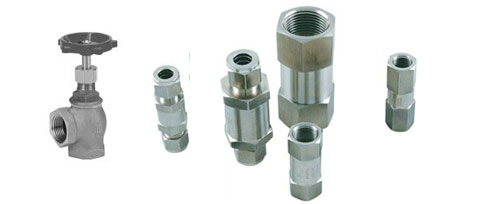
A ball check valve is a check valve in which the closing member, the movable part to block the flow, is a spherical ball. In some (but not all) ball check valves, the ball is spring-loaded to help keep it shut.Check valves are mechanical valves that permit gases and liquids to flow in only one direction, preventing process flow from reversing. They are classified as one-way directional valves. Fluid flow in the desired direction opens the valve, while backflow forces the valve closed. The mechanics of check valve operation are not complicated.
The main function of check valves is to close upon forward-flow stoppage and prevent or minimize the development of reverse flow.This function helps to protect pumps and systems from damage caused by reverse flow. Check valves are also used to isolate areas of plants, such as nuclear power plants, from over-pressurizing or being contaminated.
Types Of Check Valve
Swing check valves.
Swing check valves are the most common and best check valve for general-purpose use (Image 1). Of all check valve designs, these valves produce the lowest pressure drop, when compared with other check valves of the same size. They feature a simple design that is easy to maintain.
The swing check valve functions by allowing flow forces to move the disc from the closed position to the fully open position in a sweeping arc motion against the hinge-stop inside of the valve body. Due to the weight and center-of-gravity location of the disc and swing-arm assembly, the valve will return to the closed position should flow become interrupted or reversed. External counterweights mounted on the hinge pin are sometimes used to increase or decrease the reaction time and speed of the disc returning to the closed position. Seating surfaces are typically flat, which means the radial disc positioning onto the seat is not critical, except that it must be flat onto the seat. The disc/hinge assembly design differs among manufacturers and application industries, with some designs using separate hinges and discs and others having a single piece.
Swing check valve discs are not stable unless they are in systems with steady flow and are in the fully open position. As the disc/hinge assembly center of rotation is a fair distance from its pivot point, it will take a relatively long period of time for swing check valves to close upon flow stoppage or reversal. During this time, reverse-flow forces may experience a large increase in energy from flow and pressure buildup. This situation can cause high-energy water hammer when the disc slams onto the seat.
Tilting disc check valves.
Lift check valves are also called piston checks by some manufacturers (Images 5 and 6). They are essentially globe valves without the stem and top works, allowing the disc to respond to flow rates and direction. The disc has linear movement and is typically body-guided with conical seating surfaces. Springs can be added above the disc to provide more closure force when the disc returns to its closed position. Some manufacturers include externally attached equalizer piping to increase the disc opening with lower flows. The equalizer pipe is an open-pressure communication device that maintains equal pressure above the disc and in the piping downstream of the disc.
Stop-check valves.
Stop-check valves are essentially globe valves with a stem that is not attached to the disc (Image 7). With the stem in the fully open position, the valve functions as a lift check valve. With the stem in the closed position, the valve functions as a stop valve to isolate flow in either direction.All remaining valve characteristics are the same as those of the lift check valve, plus the inclusion of the stem and top works of a globe valve.
In-line check valve.
In-line check valves prevent reverse flow with disc movement that is parallel with the flow (Images 8 and 9). With this design, the disc is always in the flow path. The actual designs of these valves vary greatly between design models and manufacturers. Some have flat seats, and others use conical and multiple seats. Most discs are spring-loaded to assist in seating. These check valves are bonnetless and are often installed between flanges (wafer style). The in-line check valve disc has very short disc travel and responds very quickly to flow stoppage or reversal, thus minimizing the potential for water hammer. It is somewhat better than the tilting disc check valve at minimizing potential water hammer, but with a higher pressure drop.
Dual-plate check valve.
Dual-plate check valves are similar to in-line check valves in that they are bonnetless and mounted between pipe flanges (wafer style, Image 10). In this case, the valve includes two spring loaded half-moon shaped discs that rotate about their shaft. The actual designs of these valves vary between design models and manufacturers. Most have multiple flat seats. The dual-plate check valve disc has short rotational disc travel and responds quickly to flow stoppage or reversal, thus the potential for moderate water hammer does exist. It is somewhat better than the swing check valve at minimizing potential water hammer, but with a much higher pressure drop.
Check Valve Selection
Similar to determining the size of the check valve, selecting the type of check valve requires the knowledge of check valve performance characteristics and all piping system requirements. Each type of check valve has its own set of performance characteristics, which must be matched with the piping system requirements to determine the proper check valve type.
Unfortunately, most check valve applications have multiple requirements, which might not all match with a single type of check valve. Often, the final type of check valve selected is a compromise, driven by the most prevalent requirements.
Proper check valve selection and sizing requires complete knowledge of the piping system conditions and specifications, and the performance characteristics of each type of check valve. The system engineer and supplier must work together to optimize these items to ensure the check valve and the system are a proper match. Without this collaboration, either the system will not perform at optimal efficiency or the check valve will require increased maintenance.
Manufacturer or Supplier of Product:
Relative Site (URL):