
Ball valve
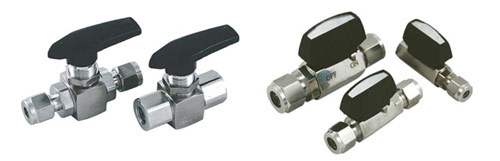
A ball valve is a valve that opens by turning a handle attached to a ball inside the valve. The ball has a hole, or port, through the middle so that when the port is in line with both ends of the valve, flow will occur. When the valve is closed, the hole is perpendicular to the ends of the valve, and flow is blocked. The handle or lever will be inline with the port position letting you "see"the valve's position.
Remy Ball valves are durable and usually work to achieve perfect shutoff even after years of disuse. They are therefore an excellent choice for shutoff applications (and are often preferred to globe valves and gate valves for this purpose). They do not offer the fine control that may be necessary in throttling applications but are sometimes used for this purpose.
Remy Ball valves are used extensively in industry because they are very versatile, pressures up to 10,000 psi, temperatures up to 200 Deg C. Sizes from 1/4" to 12" are readily available They are easy to repair, operate manually or by actuators.
Types of ball valve
Ball valves, as the name implies, are stop valves that use a ball to stop or start the flow of fluid. The ball (fig 9-22) performs the same function as the disk in the globe valve. When the valve handle is operated to open the valve, the ball rotates to a point where the hole through the ball is in line with the valve body inlet and outlet. When the valve is shut, which requires only a 90-degree rotation of the handwheel for most valves, the ball is rotated so the hole is perpendicular to the flow openings of the valve body, and flow is stopped.
Most ball valves are of the quick-acting type (requiring only a 90-degree turn to operate the valve either completely open or closed), but many are planetary gear operated. This type of gearing allows the use of a relatively small handwheel and operating force to operate a fairly large valve. The gearing does, however, increase the operating time for the valve. Some ball valves contain a swing check located within the ball to give the valve a check valve feature. Ball valves are normally found in the following systems aboard ship: seawater, sanitary, trim and drain, air, hydraulic, and oil transfer.
There are three different types of ball valve. A full port ball valve offers no flow restriction, which means that when the ball valve is open, the liquid can flow freely through it. This is achieved by making the ball larger than the passage size, so that the hole bored through it can be the same size as the passage. A standard port ball valve does not have an oversized ball, and as a result the hole is one size smaller than the passageway. This presents a small amount of flow restriction as the fluid passes through the ball valve. A reduced port ball valve, on the other hand, has an even smaller ball and an even smaller hole, which creates significant flow restriction as the fluid passes through the valve.
Manufacturer or Supplier of Product:
Relative Site (URL):