
Tube to Union
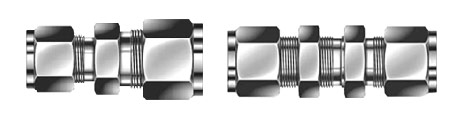
A union is just similar to a coupling,it is one of the most important and multi purpose fitting, having number of applications. They are widely used in tube fittings and are available in a range of materials including brass, aluminium, bronze, copper, plastic, stainless steel etc, depending on their end use. These products are used for tube to tube piping and the fitting size is generally based on the inside or the outside diameter. Nickle or chrome plating is sometimes provided on unions for appearance and corrosion resistance. Tube union are manufactured with high precision standards to ensure high level of quality.
In addition to a standard union, there exist dielectric unions which are used to separate dissimilar metals (such as copper and galvanized steel) to avoid the damaging effects of galvanic corrosion. When two dissimilar metals are placed in an acidic solution (most tap water is mildly acidic), they will form a battery and generate a voltage by electrolysis. When the two metals are in contact with each other the current from one metal to the other will cause a movement of ions from one to the other, dissolving one metal and depositing it on the other. A dielectric union breaks the electric current with a plastic liner between two halves of the union, thus limiting galvanic corrosion.
Materials of Tube to Union
The 'bodies' of Tube to Union are most of the same base material as the pipe or tubing being connected, such as steel,copper, polyvinyl chloride (PVC), chlorinated polyvinyl chloride (CPVC) ie; PlatinumXCELL Flowguard or or other plastic. but any material that is allowed by code may be used, must be compatible with the other materials in the system, the fluids being transported, and the temperatures and pressures inside and outside of the system.
Types of Tube to Union
- Bulkhead union
- Reducing union
- Union connector
- Union tee
- Union elbow
Application of Tube to Union
Union are essentially used for piping of tube to tube industrial fittings and connect fractional tubes. These metal fittings offer high mechanical connections for vacuum applications and positive pressure in tube to tube piping systems. Union cross are so designed, that they can be used with orbital weld equipment, these unique fittings have enhanced surface to prevent out gassing and prevent corrosion.
These widely used tube fittings allow smooth flow paths and prevent any kind of turbulence or entrapments. These tubing connections eliminate costly, hazardous leaks in instrumentation and process tubing and are available in metric and inches specifications according to various applications.
Selection of Tube to Union
Selecting the proper fitting is an important. This selection process is driven by the following fluid system parameters: size, temperature, application, media, and pressure, often referred to as the acronym STAMP.
Size: Consider wall thickness Consider the wall thickness and the tube outside diameter (OD) for all tube fittingsfor . Most types are limited due to tube wall thickness. For example,flareless bite-type fittings have minimum wall limitations, and Flare-type fittings typically have a maximum tube-wall limitation, Select tube OD and wall thickness based on pressure, flow rate, temperature, and other ambient conditions.
Temperature: Temperature range for fittings depends on plating,material, and type of seal. The accompanying table lists temperature ranges for the most common fitting and seal materials.
Application: System environment obviously influences fitting selection. Steel fittings usually have protective coatings to resist corrosion. For more-corrosive environments, stainless steel and brass are viable options. Also consider the severity of the application, such as whether operating conditions are static or dynamic, and potential consequences of failure when selecting fittings.
Media:The fluid media must be considered when selecting fitting and seal materials. Consult fluid-compatibility tables for recommendations.
Pressure: The fitting’s pressure rating must equal or exceed system pressure. Ratings are based on a ratio of the ultimate strength of the fitting material and the pressure-holding capacity of the particular joint design. This provides a measure of safety against unknowns in material and operating conditions. Tube fittings are customarily rated with a 4:1 design factor for normal operating conditions and moderate mechanical and hydraulic shocks.
Manufacturer or Supplier of Product:
Relative Site (URL):