
Tube to SAE O-Ring Seal
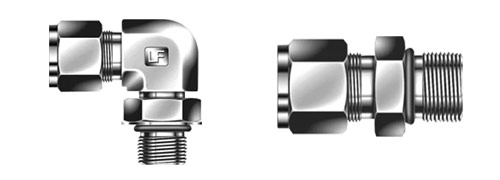
The O-ring Face Seal uses an O-ring (SAE J515) in a groove on the male face side. This is mated to flat face without an O-ring on the female swivel side, forming a seal without metal deformation much the same as an SAE four bolt split flange connection without the bolts. The O-ring face seal connection has been tested to SAE J343 tests and procedures and meets or exceeds SAE J1453 specifications. This connector has proven its superiority in leak resistance, ease of installation, high operating pressure, increased torque tolerance and reusability with regard to its ability to be connected and disconnected frequently. It is one of the fastest growing categories because O-ring face seal fittings can eliminate leaks in high-pressure hydraulic systems despite severe mechanical shocks and vibration.
the construction of O-ring Face Seal
The fitting has a body, tube nut, sleeve, and O-ring. The O-ring seats in a groove on the fitting’s flat face. The sleeve permanently attaches to the tube either mechanically (by flanging) or by brazing.
As the nut tightens onto the fitting body, it compresses the O-ring between the body and flat face of the tube flange (or braze sleeve) to form a tight seal. O-rings provide a more-reliable seal than traditional metal-to-metal connections, though it comes with more-restrictive media and temperature limitations.
Maximum operating pressure is generally 6,000 psi for sizes to 1 in. and 4,000 psi for 1.25 and 1.50-in. sizes. Temperature range depends on the seal material. Nitrile is most common and typically has a range of –30 to 250°F. Fluorocarbon O-rings handle temperatures to 400°F, while other materials suit various fluids and temperatures.
The range of tube-wall thicknesses for O-ring face seal fittings exceed that of other types. Brazed fittings are recommended for thin to heavy-wall tubing, while mechanical-flange construction has a more-limited tube wall range.
ORFS fittings require no tube entry during installation and conform to performance and dimensional requirements of SAE J1453 and ISO 8434-3.
60° Cone: These fittings typically connect to hose or another fitting. They are seldom used with tube. It forms a metal-to-metal seal between the surface of the 60° cone and mating seat of the hose fitting or adapter. Threads provide a clamping load, not sealing. Four types commonly used in hydraulic applications are SAE J516/J514, JIS B8363 Code C and R, BS B5200, and DIN 7631.
SAE J516/J514 fittings’ NPT/NPTF male threads mate with NPSM female threads usually found on swivel-hose ends and other adapters. Prior to assembly, ensure that the NPT/NPTF thread has a 60° cone seat (30° chamfer). This is critical because most NPT/NPTF threaded male ends do not have the required 30° chamfer.
JIS B8363 (Code C and R) versions typically serve as hose adapters on equipment designed or manufactured in Japan and Korea.
BS B5200 styles typically handle the same applications, but mostly on equipment from England and other European countries.
Even though JIS and BS fittings have the same BSPP thread and seat angle, other dimensions are not identical. Hence, in some instances these fittings will not function properly if installers interchange components. For example, interchanging JIS and BS components can cause leaks due to different thread lengths and chamfer diameters that cause the swivel nut to contact the body before the fitting seals. The BS B5200 is also designed as a dual-function end connection (hose and port end connection). With the appropriate bonded seal, it attaches to DIN 3852-2 type ports (BSPP ports with flat face seals).
DIN 7631 versions are the least widely used of all 60° cone fittings. Its distinguishing characteristic is metric parallel threads instead of BSPP threads.
Generally, 60° cone fittings are for applications with pressures ranging from 1,100 to 5,000 psi.
Selection of O-Ring Seal
Selecting the proper fitting is an important. This selection process is driven by the following fluid system parameters: size, temperature, application, media, and pressure
Manufacturer or Supplier of Product:
Relative Site (URL):